

Wildfire Smoke and the Importance of Hospital Air Filtration
Wildfire smoke can affect hospital air quality. Learn the importance of filtration in Modular Operating Theatre Indonesia by PT MACI.
Forest and land fires, commonly known as karhutla in Indonesia, can have a much broader impact, especially on hospital environments. Smoke carried by the wind can reduce air quality across different regions and increase exposure to fine particles such as PM2.5.
In August 2026, Indonesia’s Ministry of Health even reported that several areas affected by forest and land fires had reached very unhealthy to hazardous air quality levels, with PM2.5 identified as one of the critical parameters.
Under these conditions, hospitals need to make extra efforts to maintain air quality so that the environment remains safe and comfortable for patients and healthcare workers. This is especially important because several areas within hospitals require stricter air control due to their direct connection with medical services.
One of the most critical areas where air quality must be carefully maintained is the hospital operating room. This area requires controlled air quality to support medical procedures. Therefore, air filtration systems play an important role in the planning of Modular Operating Theatre Indonesia, particularly in helping ensure that the air supplied to the operating room meets the environmental requirements of the space.
Impact of Wildfire Smoke on Hospital Air Quality
Exposure to wildfire smoke can increase the risk of respiratory problems such as acute respiratory infections, especially among more vulnerable groups. However, the impact is not limited to patients. Wildfire smoke in hospitals can also become a challenge for healthcare facilities in maintaining hospital air quality, particularly when particulates and pollutants begin to affect indoor air conditions.
Several impacts need to be considered, including:
1. Increased PM2.5 Pollution
One of the main pollutants associated with wildfire smoke is PM2.5, which consists of very fine particles that can travel with smoke across wide areas. When PM2.5 concentrations rise outdoors, hospital environments may also be affected, especially if the air management system is unable to filter particulates effectively.
This makes hospital air quality an important concern during wildfire periods. Healthcare facilities accommodate patients with a wide range of health conditions, some of whom may be more sensitive to air pollution exposure.
2. Risk of Indoor Air Contamination
Wildfire smoke does not necessarily remain outside the building. Particulates and pollutants can enter through supply air, building gaps, or frequent movement in and out of rooms if ventilation and air filtration systems are not functioning properly.
In hospital areas that require stricter air control, this condition cannot be overlooked. Ventilation and filtration systems therefore need to be designed according to the function of each room, including operating room air filtration, which plays an important role in maintaining environmental conditions in critical areas.
3. Reduced Comfort and Environmental Quality in Hospitals
Air containing smoke, odors, and particulates can also reduce comfort for patients, healthcare workers, and visitors. For patients undergoing treatment, a comfortable environment can support their overall experience while staying in a healthcare facility.
In critical areas such as operating rooms, the challenge is even greater because air quality needs to be controlled more strictly. This is why, in Modular Operating Theatre Indonesia, the filtration system does not function as a standalone component, but as part of an integrated operating room system designed to help maintain air conditions according to the needs of the space.
The Importance of Air Filtration in Operating Rooms
Operating rooms require more specific air management compared with general areas in hospitals. Filtration is one of the key elements that helps control particulates in the air before it is distributed into the room. In Modular Operating Theatre Indonesia, this function is designed as part of the overall operating room system.
1. Reducing Particulates from Supply Air
Operating room air filtration helps reduce particles carried through the supply air stream. This becomes increasingly important when outdoor air quality deteriorates due to smoke, dust, or other environmental conditions.
Filtration performance is also influenced by how air is distributed and how the overall operating room HVAC system is designed and maintained. Therefore, filters should not be considered the only factor that determines air quality.
2. Supporting Air Quality Control in Operating Areas
Operating room HEPA filters can serve as part of the filtration system to help capture fine particulates before the air is distributed to the designated area.
However, operating room HEPA filters are not a standalone solution. They need to function as part of a ventilation and air management system designed according to the specific requirements of the room. This is why Modular Operating Theatre Indonesia places filtration as part of an integrated system rather than as a separate component.
3. Helping Maintain Air Management System Performance
Filters that are excessively dirty or unsuitable for the room’s requirements can affect airflow and cause the system to work harder. Therefore, hospitals need to monitor filter conditions as part of regular air management system evaluations.
For both new construction and hospital operating room upgrades, filtration requirements should be considered together with HVAC conditions and the overall room design.
The Best Air Management System in PT MACI Modular Operating Theatre
After understanding the importance of air filtration, hospitals also need to consider the operating room air management system as a whole. In Modular Operating Theatre Indonesia, air quality does not depend on a single type of filter, but on how HVAC, filtration, air distribution, and room structure are designed to work together as an integrated system.
For this reason, PT MACI designs the air management system as an integral part of the entire Modular Operating Theatre rather than as a standalone component. Several important aspects support this system.
1. Air Filtration System with HEPA Filters
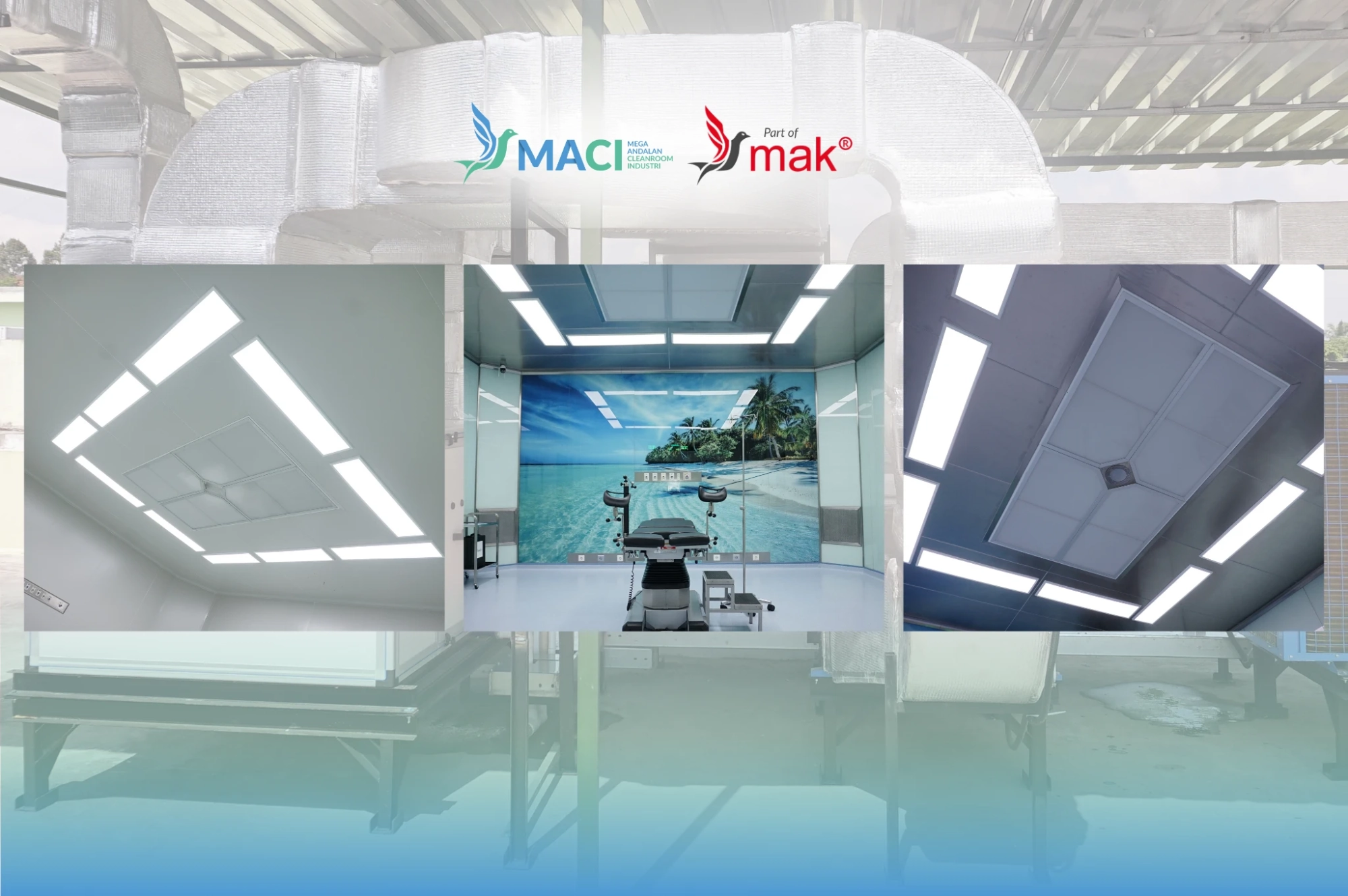
Operating room air filtration plays an important role in helping remove particulates before air is distributed into the room. One of the components used is an operating room HEPA filter, which provides high-efficiency filtration to help maintain air cleanliness in critical areas.
However, HEPA filter performance is not determined solely by the type of filter used. The system must also be supported by proper airflow and installation so that filtration can perform optimally. This is why, in Modular Operating Theatre Indonesia, the filtration system is planned as part of the entire operating room air management system.
2. Customized HVAC System for Operating Room Requirements
Every hospital has different operating room requirements in terms of room size, capacity, function, and service needs. Therefore, the operating room HVAC system at PT MACI is designed in a customized manner to suit the needs of each healthcare facility.
The design does not only focus on cooling the room, but also considers air distribution, temperature, humidity, room pressure, and filtration requirements. With this approach, the operating room ventilation system can be designed to better match the characteristics and function of the room.
This customized approach also helps hospitals obtain an air management system that does not simply follow a standard design, but is tailored to operational needs and overall room integration.
3. Integrated with the Entire Modular Operating Theatre System
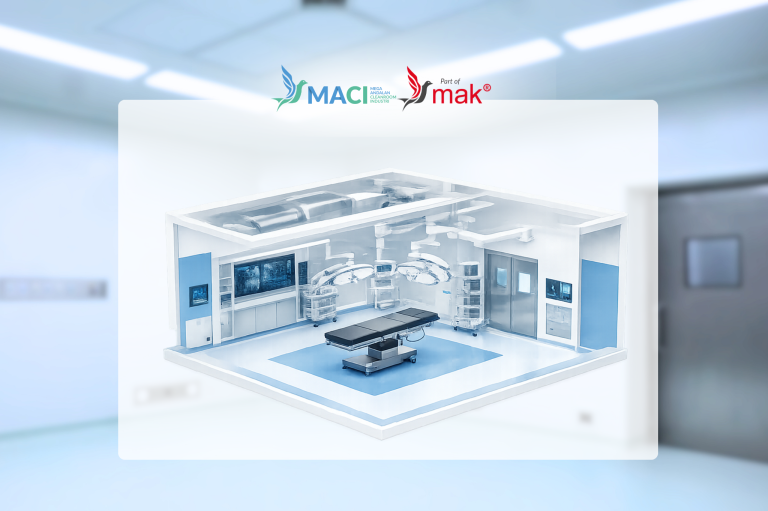
An air management system cannot perform optimally if it is designed separately from other operating room elements. Therefore, in Modular Operating Theatre Indonesia, HVAC and filtration are planned together with modular walls and ceilings, hermetic doors, control panels, lighting, medical gas systems, and other supporting equipment.
This integration is important in helping maintain hospital air quality, particularly in operating room areas that require stricter environmental control. Each component needs to support the others so that room conditions can be maintained according to operational requirements.
With this approach, PT MACI does not provide the operating room HVAC system or operating room HEPA filters as separate standalone solutions, but integrates them into a complete Modular Operating Theatre system that is designed comprehensively and cohesively.
Deliver the Best Air Management System with PT MACI Modular Operating Theatre
Amid the risk of declining air quality caused by wildfire smoke, hospitals need to ensure that critical areas such as operating rooms remain supported by a controlled air management system. For this reason, air management should not rely solely on filters, but should be designed as part of the entire Modular Operating Theatre Indonesia system.
PT Mega Andalan Cleanroom Industri provides Modular Operating Theatre solutions with an integrated approach and HVAC systems that can be customized according to each facility’s needs. From the operating room HVAC system and operating room HEPA filters to modular walls and ceilings, hermetic doors, control panels, medical gas systems, lighting, and supporting equipment, every component is planned as part of one integrated system to help maintain hospital air quality according to the requirements of the operating area.
For hospitals planning new construction or a hospital operating room upgrade, the issue of wildfire smoke serves as a reminder that air management system readiness should not be overlooked. Trust PT MACI for your Modular Operating Theatre needs and create a modern, integrated operating room tailored to the requirements of today’s healthcare facilities.