

Signs Your Operating Room HVAC System Is Declining

Operating room HVAC needs to be evaluated when temperature, humidity, air pressure, airflow, filters, and system performance begin to become unstable.
After previously discussing the importance of hospital operating room system evaluation, it is known that HVAC is one of the components that requires the most attention. This is because operating room HVAC functions to maintain air conditions, temperature, humidity, room pressure, airflow, and air filtration according to the needs of the operating room.
Therefore, the HVAC system in an operating room cannot be treated like HVAC in a general building.
Over time, operating room HVAC also has a performance limit. Due to usage intensity, the system may experience a decline in performance. That is why hospitals need to understand the signs early so disruptions do not develop into bigger problems.
Why Does Operating Room HVAC Need to Be Evaluated?
There are at least several reasons why operating room HVAC needs to be evaluated regularly, including:
1. Related to Operating Room Air Quality
HVAC helps maintain air circulation and filtration in the Operating Room. Therefore, this system must be ensured to keep working according to its function so the air conditions inside the room remain controlled.
2. Supporting Temperature and Humidity Stability
Operating rooms require stable temperature and humidity. When air conditions are inconsistent, the comfort of the medical team and the stability of the operating room environment can be disrupted.
3. Affecting Room Pressure
Room pressure must be maintained so airflow remains according to the design. If the pressure is unstable, the overall performance of the operating room can also be affected.
Signs That the operating room HVAC system Is Declining
A decline in operating room HVAC performance is not always immediately visible. In some cases, disruptions are only felt when the system starts struggling to maintain room conditions according to the required needs. Therefore, hospitals need to pay attention to the following signs.
1. Operating Room Temperature Is Difficult to Stabilize
One of the early Signs That the HVAC system is starting to decline is when the operating room temperature becomes difficult to stabilize. For example, the room feels too cold, too hot, or keeps changing even though the settings have been adjusted.
This condition may indicate issues with the cooling system, sensors, controls, or air distribution. If left unresolved, unstable temperature can affect the comfort of the medical team and the smooth operation of activities in the operating room.
2. Humidity Is Not Controlled
In addition to temperature, humidity is also an important factor in the operating room. Operating room temperature and humidity need to be maintained so the room condition remains stable according to medical service needs.
If humidity is too high or too low, it may be a sign that the HVAC system is not working optimally. Therefore, humidity conditions need to be monitored regularly as part of system performance evaluation.
3. Operating Room Air Pressure Is Not Appropriate
Unstable operating room air pressure may indicate disruptions in airflow, balancing, filters, or other HVAC components. In an operating room, air pressure plays an important role in maintaining airflow direction according to the design.
If room pressure is not appropriate, the system needs further evaluation. This inspection is important to determine whether the problem comes from the HVAC unit, filters, ducting, doors, or the control system connected to the operating room.
4. Airflow Feels Uneven
Uneven airflow can also be a sign that the HVAC system is starting to decline in performance. For example, some areas may feel like they receive airflow that is too strong, while other areas may feel like they do not get enough air circulation.
In the operating room, airflow needs to be designed and maintained according to room requirements. If airflow is uneven, the system should be inspected to ensure air distribution continues to run according to the design.
5. Filters Get Dirty Faster or Need to Be Replaced More Often
Operating room HEPA filters play an important role in supporting air filtration. However, if the filters get dirty faster or need to be replaced more often than usual, this may be a sign that the system workload is too heavy or maintenance has not been carried out optimally.
Filter condition can also affect airflow and HVAC system efficiency. Therefore, filter inspection should be part of routine evaluation to keep system performance maintained.
6. The System Experiences More Frequent Alarms or Disruptions
Another sign to pay attention to is repeated alarms, warnings, or system disruptions. For example, sensors become inconsistent, the system often needs to be reset, or the panel shows certain warnings.
These disruptions should not be considered minor issues. If they happen repeatedly, the Hospital Needs to conduct a comprehensive evaluation to identify the root cause and determine the right corrective action.
7. Energy Consumption Increases
An HVAC system with declining performance usually has to work harder to achieve the same room conditions. As a result, energy consumption may increase even though operational needs have not changed significantly.
This condition may indicate that the system is no longer working efficiently. Evaluation is needed to determine whether the issue comes from components, controls, filters, or the air distribution system.
8. Maintenance Is Needed More Frequently
If minor repairs keep recurring, this may be a sign that the system requires a more comprehensive evaluation. More frequent maintenance not only disrupts operations but can also increase maintenance costs.
In certain conditions, the hospital needs to consider whether the system is still worth maintaining or needs to be upgraded.
What Happens If Operating Room HVAC Is Not Evaluated Immediately?
If operating room HVAC with declining performance is not evaluated immediately, it can affect the overall operation of the operating room. Small issues that continue to occur repeatedly may develop into more complex disruptions, such as:
- Operating Room Stability Can Be Disrupted
- Operational Efficiency Can Decrease
- Maintenance Costs Can Increase
Therefore, hospital operating room upgrades can be considered when the HVAC system is no longer stable, experiences disruptions too often, is difficult to maintain, inefficient, or no longer meets current medical service needs.
In many cases, an upgrade does not always mean building a new operating room from scratch. Hospitals can carry out improvements gradually based on priority needs, starting with the system that has the greatest impact on operating room operations.
Present Modular Operating Theatre with an Integrated HVAC System with PT MACI
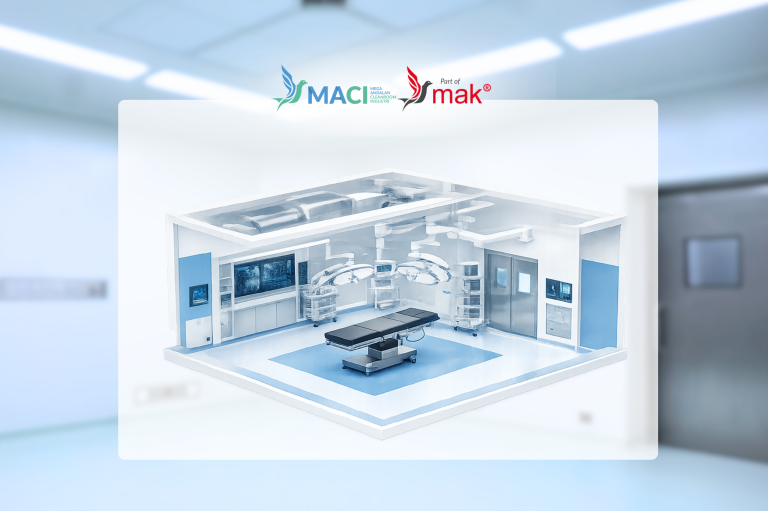
As part of modular operating theatre Indonesia, operating room HVAC cannot be designed separately from other components. This system needs to be connected with operating room panels, hermetic doors, control panels, medical gas, lighting, and supporting equipment so that every element inside the operating room can work safely, stably, and in an integrated way.
As a cleanroom contractor Indonesia, PT Mega Andalan Cleanroom Industri ensures that the Modular Operating Theatre is designed with a comprehensive approach. From room planning, material selection, HVAC systems, component installation, to system integration, every detail is considered so the operating room can optimally support hospital surgical service needs.
Ultimately, operating room HVAC is not only about comfortable air. More than that, this system plays an important role in maintaining the stability of the operating room environment, including temperature, humidity, room pressure, airflow, and filtration. Therefore, its planning needs to be part of an integrated MOT development.
With its experience and technical capabilities, PT MACI is ready to become a hospital partner in delivering a modern, integrated Modular Operating Theatre that meets the needs of today’s healthcare facilities.
Entrust your operating room HVAC system and hospital Modular Operating Theatre needs to PT Mega Andalan Cleanroom Industri